You’ve surely seen it more than once: a player with excellent technique who, in the match, dribbles when he should pass or shoots when a team-mate was free. And on the other hand, players who aren’t the fastest or the most skilful yet always seem to do the right thing. The difference usually lies in decision-making in football.
Many people think this is something you’re born with, what we call “having vision”. My experience as a coach tells me otherwise: good decision-making can be trained. In this article I explain what lies behind a good decision, why technique alone isn’t enough and how we work on it in our technical training sessions in Alcalá de Henares.
What making good decisions on a football pitch means
Every time a player takes part in a move, they go through three steps, often in less time than it takes to describe them:
- Perceive: look at where the ball, opponents, team-mates and spaces are.
- Decide: choose between the available options, such as passing, dribbling, taking on an opponent or finishing.
- Execute: carry out the action with the right technique.
When a move goes wrong, we tend to look only at the third step: “that was a bad pass”. But the error often came earlier. The player hadn’t looked, or looked too late, and by the time the ball arrived there were no good options left.
Why technique alone isn’t enough
Technique and decision-making go hand in hand. A player who masters the ball has more options to choose from and can look up because they don’t need to watch it all the time. But if they only repeat movements with no opponents or context, they learn to execute, not to solve problems.
That’s why we don’t separate one from the other. A directional first touch, for example, is already a decision: the player has to know where they’re going to play before the ball arrives.
Common decision-making errors in youth football
These are the ones we see most in young players. They’re normal during development and can be improved:
- Looking only at the ball and noticing the opponent’s pressure when it’s already too late.
- Deciding before seeing: planning to take someone on whatever happens.
- Always choosing the same thing, which makes the player predictable.
- Rushing out of fear of making a mistake and getting rid of the ball even when there’s time.
- Thinking only of themselves and not seeing the better-placed team-mate.
How we work on decision-making at MR Fútbol
Our technical training sessions last 60 minutes and always follow four blocks. Decision-making is present in all of them:
1. Warm-up game
We start with a game linked to the day’s objective. From the first minute, the player has to be alert and solve situations, not just warm up.
2. Passing, body shape and control
Good body shape lets you see more of the pitch and therefore have more options. Here we insist on looking before receiving and on every touch preparing the next action.
3. 1v1, 1v2 y 2v1
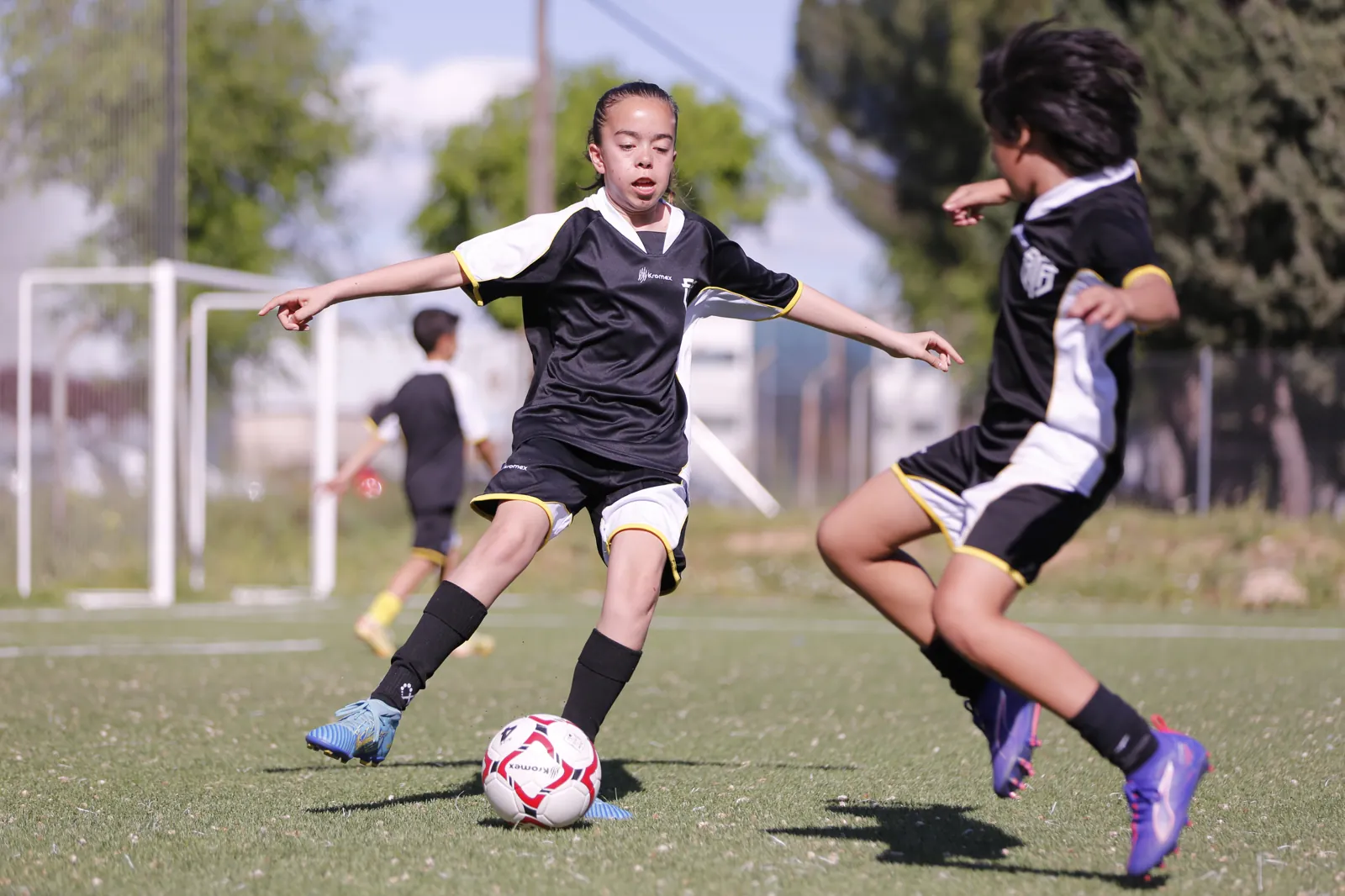
This is where it shows most. In a 2v1 the player has to read the defender: if they come to me, I pass; if they stay with my team-mate, I keep going. In a 1v2 the decision changes, because you also need to know how to shield the ball or escape the pressure. And in a 1v1, measuring the opponent, committing them and adjusting the distance are all part of the same decision. We explain this in detail in our article on how to improve your dribbling.
4. Finishing on goal
We vary the way of finishing so the player doesn’t always repeat the same movement, but chooses how to finish according to the situation: placing it, aiming it or striking it harder.
With a maximum of 10 players and 2 coaches per group, we can give individual feedback. And there’s an important detail here: to learn how to decide, a question sometimes helps more than an order. “What did you see?”, “what other option did you have?”. If the answer comes from the player, they’re more likely to remember it in the next move.
How families can help
What happens off the pitch also influences how a player decides. Three simple ideas:
- Don’t tell them what to do during the match. If they hear “pass!” or “shoot!” from the stands, they stop watching the pitch and decide based on what they hear. You take away their chance to learn.
- Ask rather than correct. A “which move did you like most?” on the way home helps more than going over their mistakes.
- Value the decision, not just the result. A good pass that a team-mate doesn’t take advantage of is still a good decision.
If you want to go deeper, we have an article on how to help your child improve without putting pressure on them.
Three habits players can practise on their own
- Look before receiving: in any training session or match, make a point of looking to the sides before the ball arrives.
- Play in small spaces with friends: small-sided kickabouts force you to solve things quickly.
- Watch matches focusing on one player: see what they do off the ball, when they look up and what they choose.
Frequently asked questions
At what age can you start working on decision-making?
From an early age, always through play and adapting the demands to each age. Players aged 5 to 17 train at our academy, and what changes over the years is how difficult the situations they have to solve are.
Can you improve with just one session a week?
Yes, if it’s complementary work. The player keeps training and competing with their club, and at MR Fútbol they spend one weekly session on their individual technique and on 1v1, 1v2 and 2v1 situations, with personal corrections. What they learn here they apply there.
My child freezes in matches. Is it a decision-making problem?
There can be several causes, such as pressure, fear of making mistakes or a lack of technical resources. An environment where they can fail without fear usually helps. Talking to their coaches is a good first step and, if the distress persists, the right thing is to consult a professional.
Come and try a session
If you want your son or daughter to learn to look, decide and execute better, come and meet us at our venues in Alcalá de Henares. Technical training costs €65/month, with no registration fee and kit included.
Book a trial session or write to us on WhatsApp on +34 644 218 207.