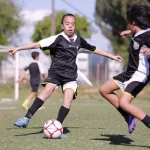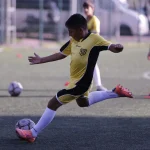
Every weekend, many families in the Corredor del Henares take their children to the pitch. Early starts, journeys, cold in the stands and a question that comes up again on the drive home: how can I help them improve without overwhelming them?
As a UEFA Pro licensed coach, I’ve seen that parents’ role in youth football weighs almost as much as the coach’s. Not because of what they teach about football, but because of how they make the player feel. In this article I share what works, what to avoid and how technical training fits into all this.
The role of parents in youth football: supporting, not coaching
Your child already has a coach at their club. If they also get instructions from the stands, in the car and at home, they receive different and often contradictory messages. The result is usually a player who doubts, who looks to the touchline before deciding and who plays afraid of making mistakes.
Your role is different, and just as important:
- Give them security: let them know you love them just the same whether they win, lose, play well or miss a penalty.
- Look after habits: rest, food, punctuality and having their kit ready.
- Keep the excitement alive: football should remain something they want to do, not an obligation.
What to say (and not say) after the match
The journey home is one of the most delicate moments. The player is tired, emotions are running high and any comment gets magnified.
Phrases that help
- “I loved watching you play.”
- “Did you enjoy it?”
- “Which of your moves did you like most?”
These are open questions that invite them to think about their own game without feeling judged. If they want to talk about the match, they will. If not, respect their silence.
Phrases to avoid
- “Why didn’t you pass in that move?”
- “The coach didn’t play you enough.”
- “You need to be more aggressive.”
Correcting tactics, questioning the coach or comparing them with team-mates puts them between two authority figures and takes away their confidence. Leave technical and tactical corrections to the coaches.
How to really help your child improve
Wanting your child to progress is the most natural thing in the world. The key is to channel that desire towards what really makes them better.
1. Value effort and learning, not just the result
In youth football, Saturday’s score says very little about a player’s future. What makes the difference is whether each week they control better, decide better and dare more. Ask them what they’ve learned, not just how many goals they scored.
2. Encourage them to play with the ball outside training
Many of the best players developed by playing with a ball in the playground, the park or against a wall. Making that free play possible, without instructions, is one of the best gifts you can give them. If they also use both feet, even better.
3. Understand that the club and individual technique are different things
At their club, your child competes and learns to play as a team. But in a group session with the whole squad it’s hard for a coach to spend time correcting each player’s technique. That’s where specific work on individual technique adds value.
Where technical training fits (and where it doesn’t)
At MR Fútbol Academy we don’t have teams or play in leagues. Our model is complementary: your child competes with their club and works on their individual technique with us. We don’t replace anyone; we add.
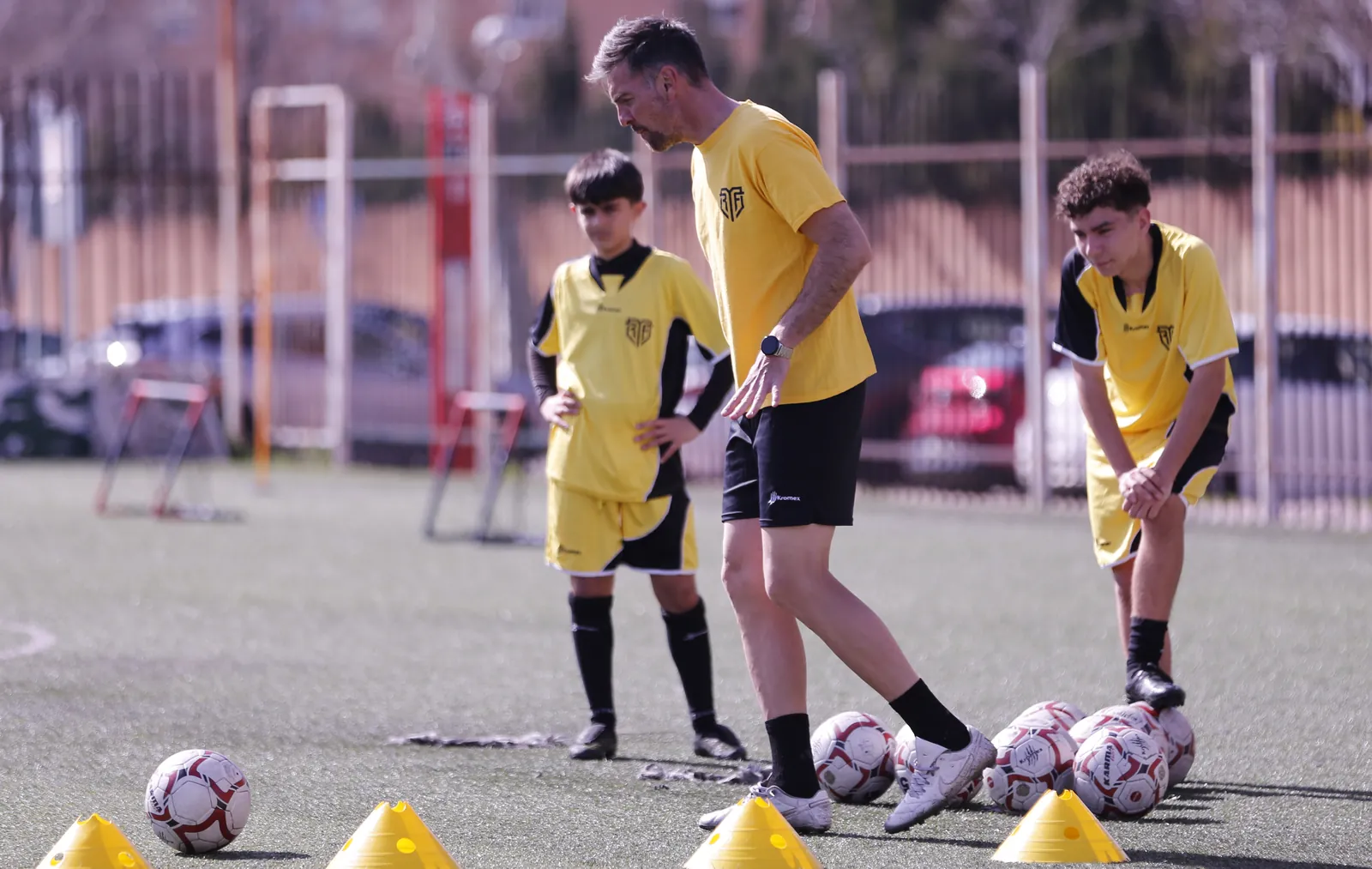
In our football technical training in Alcalá de Henares we work like this:
- 1 weekly 60-minute session.
- Groups of up to 10 players, with 2 coaches per group.
- Individual feedback in every session.
- Players aged 5 to 17.
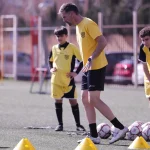
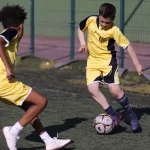
Each session follows a fixed four-block structure: a warm-up game linked to the day’s objective, a block of passing, body shape and control, 1v1, 1v2 and 2v1 situations with dribbling and decision-making, and finishing on goal with varied finishes. Everything is mirrored, on the left and on the right, to develop both feet.
If you’d like to explore this idea further, I recommend our article on technical training or competing.
Signs your child needs a change of approach
Sometimes pressure doesn’t come from a specific comment, but from the general atmosphere. Pay attention if you notice that they:
- Make excuses not to go to training when they used to love it.
- Get very nervous before matches.
- Look for you in the stands after every action.
- Only talk about football in terms of winning or losing.
None of these signs is serious on its own, but together they suggest it’s worth lowering the demands and recovering the enjoyment. Talk to your child, talk to their coach and, if you think it’s necessary, seek guidance from a sports psychology professional.
The body counts too
A growing player needs to move well: coordination, balance, strength suited to their age. At ActiveLab, our gym in Alcalá de Henares, we have programmes such as Active Kids (ages 6-9) and Active Performance (under-12 and 12+). Academy families get a 10% discount. You can read more in our guide to fitness training in youth football by age.
Frequently asked questions
Should I correct my child from the stands?
It’s best not to. Encourage them with general phrases and leave technical and tactical instructions to their coach. Getting messages from several people at once confuses them and reduces their confidence.
Is technical training compatible with training at their club?
Yes, that’s exactly the point. At MR Fútbol we don’t compete: the player stays with their club and spends one weekly session with us improving their individual technique with personal attention.
At what age can they start?
We work with players aged 5 to 17. Groups are organised so that each player trains at a suitable level. You can check timetables at our venues: Complutense in Alcalá de Henares and Gredos San Diego Alcalá.
Come and meet us
If you want your child to improve their technique in a friendly environment, with small groups and no competitive pressure, book a trial session on our contact or write to us on WhatsApp on +34 644 218 207. Technical training costs €65/month, with no registration fee and kit included.