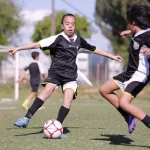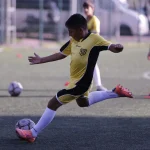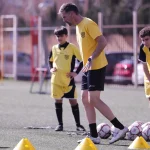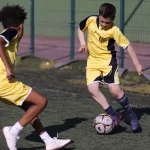
Many young players think that striking the ball well is about strength. Hitting it as hard as possible and hoping it goes in. But when you watch a footballer who strikes it with quality, what stands out isn’t power, but cleanness: the ball goes where they want, at the height and speed the move requires.
Striking the ball in football is one of the techniques that can be improved most with specific work, because it depends on concrete details that are learned, corrected and made automatic. In this article I explain, as a coach, what we look for and how we work on it in our technical training sessions in Alcalá de Henares.
Why striking the ball is much more than shooting at goal
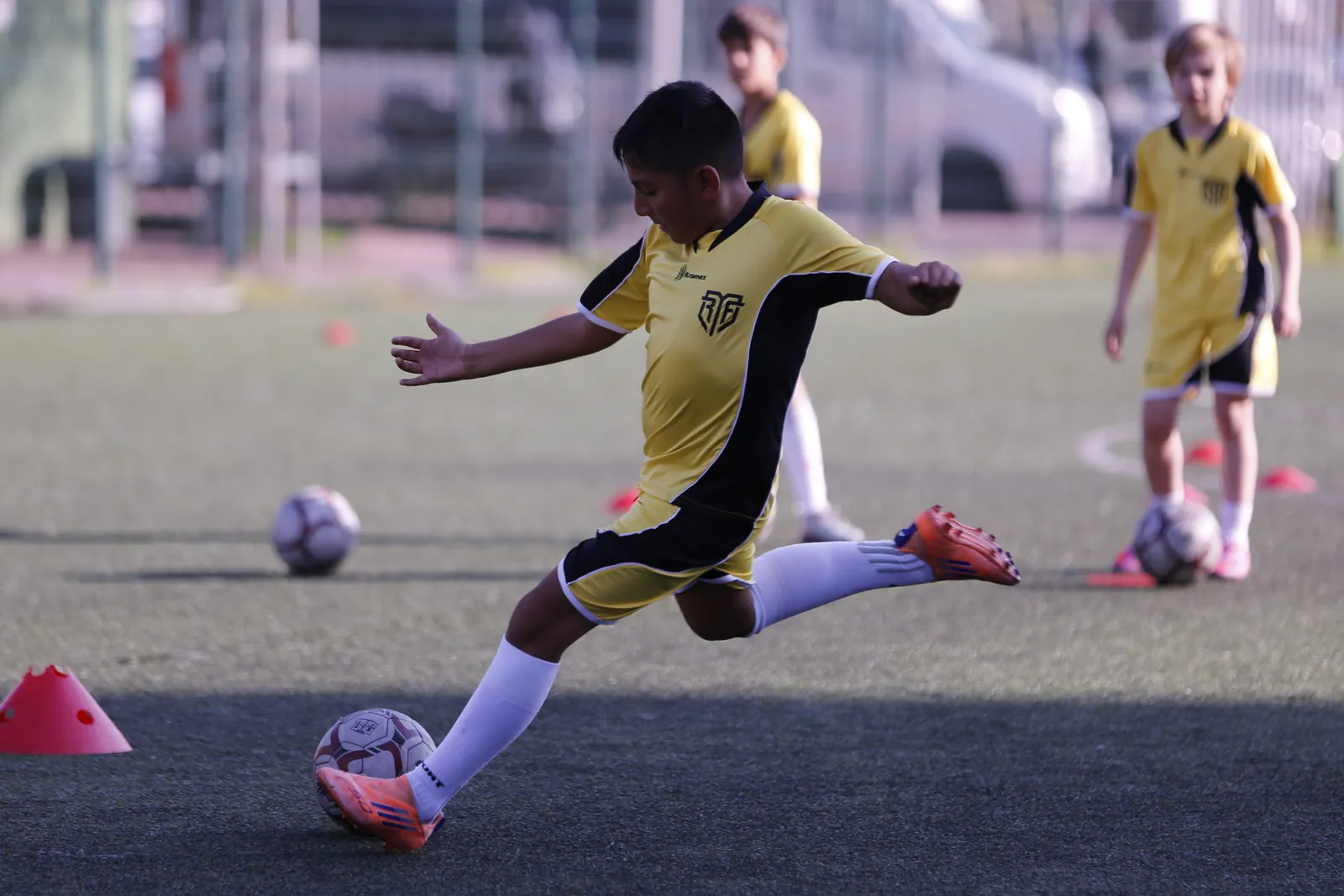
When we talk about striking the ball we don’t just mean shooting. A long pass to switch play, a cross into the box, a firm low pass between the lines or a well-directed clearance are also strikes. They all share the same technical base: how the non-kicking foot is planted, how the body is positioned and which part of the foot makes contact with the ball.
That’s why a player who improves their striking doesn’t just score more goals: they also pass better, have more options when deciding and become more useful to their team in any position.
The 4 elements of a good strike
1. The standing foot
It’s often forgotten, and yet it decides almost everything. If the standing foot is too far back, the ball tends to rise; if it’s too far from the ball, the strike loses accuracy. As a general guide, the standing foot goes beside the ball, at a comfortable distance, pointing where we want to send it.
2. Body position
For a low, firm strike, the body stays slightly over the ball. If the player leans back at the moment of contact, the ball rises out of control. The arms help with balance and the eyes should be on the ball at the moment of the strike, even if you looked up earlier to see the target.
3. The contact surface
Each part of the foot is used for something different:
- Inside of the foot: accuracy. Ideal for short and medium passes and for placing the ball on goal.
- Laces: power. Firm ankle and toes pointing down.
- Inside of the laces: long passes, crosses and curled strikes.
- Outside of the foot: passes that curve outwards and quick strikes without needing to fully set your body.
A complete player knows all these surfaces and can choose the right one for the situation. And, above all, can use them with both feet.
4. The follow-through
The strike doesn’t end when the foot touches the ball. Following the movement towards the target gives direction and continuity. Cutting the movement off usually reduces accuracy and power.
Common errors in youth football players
In our sessions we often see the same errors, and almost all of them can be solved with guided practice:
- Always striking with the toe because “it comes out harder”.
- Using only the dominant foot and avoiding the other as soon as there’s pressure.
- Not looking at the target before striking and deciding too late.
- A loose ankle at the moment of contact.
- Wanting to hit it hard in every situation, even when the move calls for placement.
None of these errors is corrected with a single tip. They’re corrected with quality repetitions and with someone watching and giving specific feedback at the right moment.
How we work on striking the ball at MR Fútbol
Our technical training sessions always follow the same four-block structure, and striking the ball appears in several of them:
- Passing, body shape and control: we work on passing with different surfaces, with good body shape and connected to the previous touch.
- 1v1, 1v2 y 2v1: striking appears as a decision: pass, dribble or finish after beating the opponent.
- Finishing on goal: the last block is dedicated to finishing, and we vary how it’s done: low, placed, with the laces, after a dribble, after a pass or after beating a player.
We also do mirrored work: everything done with the right is repeated with the left. If you want to know why we give it so much importance, we explain it in our article on how to play with both feet.
Groups have a maximum of 10 players with 2 coaches, which allows us to correct each player’s standing foot, body position or contact surface individually, not with a general instruction for everyone.
Simple exercises to practise at home or in the park
If your child wants to keep improving between sessions, these ideas will help without needing special equipment:
- Wall and accuracy: passes with the inside of the foot against a wall, alternating right and left and aiming for a specific area.
- Control and strike: receive the ball from the wall, direct it with the first touch and strike with the second.
- Targets on the ground: place two objects as a small goal and strike from different distances, first with the inside of the foot and then with the laces.
- Strike without power: practise the full movement at low intensity, focusing on the standing foot and ankle, before increasing the force.
What matters is the quality of each repetition, not the quantity. Ten good strikes are worth more than fifty careless ones.
Striking and fitness: strength, yes, but well trained
Striking power also depends on physical condition: core stability, leg strength and coordination. In developmental ages, this is worked on in an adapted, progressive way. At ActiveLab, our gym in Alcalá de Henares, the Active Performance programmes (under-12 and 12+) are designed so that young players gain strength and coordination safely. For any discomfort or physical concern, the right thing is always to consult a healthcare professional.
Frequently asked questions
At what age can you start working on striking the ball?
From the earliest ages. Players aged 5 to 17 train at our academy and striking is present at all ages, adapting the demands: with the youngest we prioritise the movement and accuracy; with older players, speed of execution and decision-making.
Should my child strike hard to score more goals?
Not necessarily. Many goals come from placing the ball well, not from power. First you need to master technique and accuracy; power comes later, once the movement is correct.
Can striking improve with just one session a week?
Yes, if the session is high quality with individual feedback, and the player keeps practising with their club. Our model is complementary: the player competes with their team and at MR Fútbol works on their individual technique in 1 weekly 60-minute session.
Book a trial session
If you want your child to improve their striking and individual technique with coaches who correct them personally, come and meet us at our venues in Alcalá de Henares. Technical training costs €65/month, with no registration fee and kit included.
Book a trial session from our contact or write to us on WhatsApp on +34 644 218 207page. See you on the pitch!