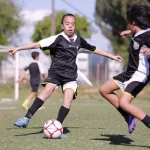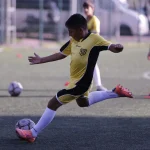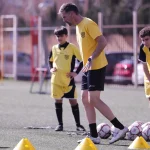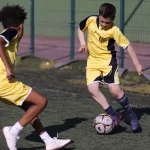
Some players seem to have more time than others. They receive the ball, and when the opponent arrives, the ball is no longer where they expected. It isn’t magic or pure speed: in most cases it’s a good directional first touch. It’s one of the technical actions that makes the most difference in youth football and, at the same time, one of the least specifically trained in teams.
I’m Rodrigo, director of MR Fútbol Academy and a UEFA Pro licensed coach. In this article I explain what a directional first touch is, why it’s so important from an early age and how we work on it in our technical training sessions in Alcalá de Henares.
What a directional first touch is in football
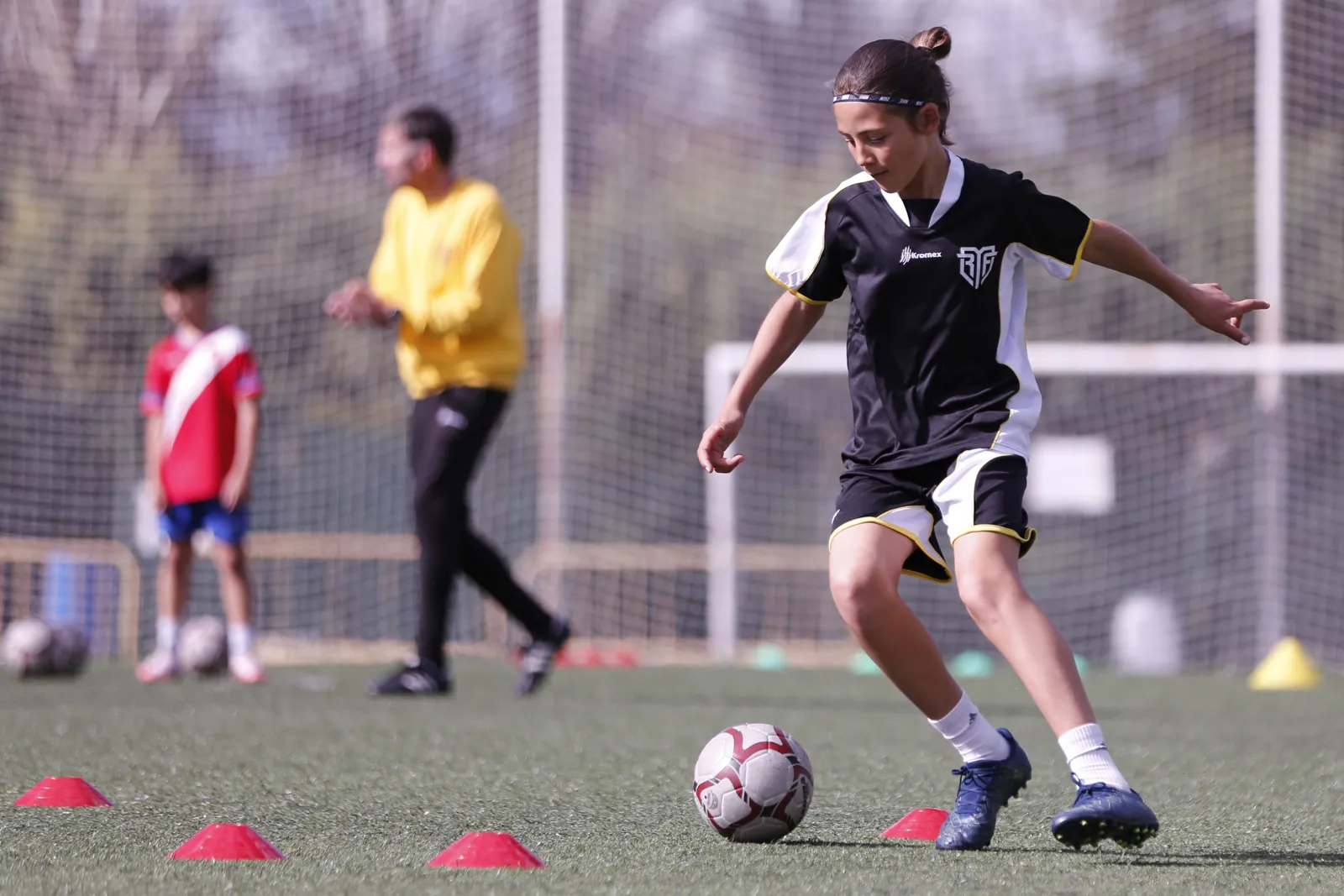
A directional first touch means receiving the ball and, with the first touch, directing it into the space where we want to play next. It isn’t about stopping the ball and then thinking what to do, but about the touch itself being the start of the next action: a pass, a run with the ball, a dribble or a shot.
The difference from a “stopping” touch is huge. When the player kills the ball dead, they need a second touch to turn, and that second touch is exactly the time the opponent uses to close the space. With a good directional first touch, the player gains that advantage before the move has even begun.
Why it’s so important in youth football
In 7-a-side and 11-a-side youth football, spaces are getting tighter and pressure arrives sooner. A child who masters the directional first touch:
- Gains time to make the next decision.
- Loses the ball less because they move it away from the opponent with the first touch.
- Plays faster without needing to be the quickest on the pitch.
- Keeps the game flowing for their team, something any club coach values.
A directional first touch also forces you to look up and check before receiving. That’s why it isn’t just a technical action: it’s closely linked to decision-making, which is what really makes a footballer grow.
The keys to a good directional first touch
1. Look before receiving
The touch is decided before the ball arrives. The player needs to know where the opponent is, where the space is and where their team-mates are. If they only look at the ball, they’ll control it well… but probably in the wrong direction.
2. Set your body correctly
Body shape is the foundation. Receiving with an open body, rather than fully facing or with your back turned, lets you see more of the pitch and direct the ball towards more options. In our sessions we place great emphasis on body shape because, without it, a directional first touch is almost impossible.
3. Choose the contact surface
Inside, outside, sole, thigh… Each surface suits a different direction and situation. A complete player needs several options and, above all, to be able to use them with both feet.
4. Cushion it and use just the right force
The ball has to end up at a distance that allows the next action: not stuck to the foot, which forces another touch, nor so far that the opponent takes it. That “right force” only comes with lots of quality repetitions.
5. Move off with the ball
A directional first touch doesn’t end when the ball touches the foot. It ends when the player is already moving towards their next action. Controlling it and standing still cancels out much of the advantage.
Common errors we see in young players
- Not looking first: technically good control, but towards the opponent.
- Always receiving with the same foot, which makes the player very predictable.
- Waiting for the ball while standing still instead of attacking it or adjusting position.
- Taking too long a touch from wanting to go fast, and losing possession.
- Closed body, back turned or square-on, which reduces the options to get away.
None of these errors is corrected by matches alone. It takes specific work, with lots of repetitions and individual correction at the right moment.
How we work on the directional first touch at MR Fútbol Academy
In our football technical training in Alcalá de Henares each session lasts 60 minutes and always follows the same four-block structure. The directional first touch appears directly in the second block, but is applied in all of them:
- Warm-up game linked to the objective: games where receiving with a directional touch gives you an advantage.
- Passing, body shape and control: the central block for this technique, with repetitions in different directions and on different surfaces.
- 1v1, 1v2 y 2v1: the directional first touch becomes the first action to beat the opponent or decide well.
- Finishing on goal: using a directional touch to set up the shot, varying the way of finishing.
We work on everything with mirrored work: what is done to the right is repeated to the left, so the player develops both feet equally. If this topic interests you, we recommend our article on how to play with both feet.
Groups have a maximum of 10 players with 2 coaches, which allows us to give individual feedback in every repetition. In such a fine action as the directional first touch, that personal correction makes the difference.
Simple exercises to practise at home
Without replacing training, there are small routines that help a lot:
- Wall and two cones: pass against a wall, and before receiving decide which cone you’re going to direct your touch towards. Alternate foot and direction.
- With a team-mate or family member: have them say “right” or “left” just before the ball arrives. That way you train looking, deciding and executing.
- Control and go: after every touch, always take two or three quick dribbles. Never stand still.
Frequently asked questions about the directional first touch
At what age do you start working on the directional first touch?
It can be introduced through play from a very young age, adapting the demands to each age. At our academy we work with players aged 5 to 17 and adjust the exercises to each group’s level and stage.
Can the directional first touch be improved if my child is already 14 or 15?
Yes. The sooner it becomes automatic the better, but it’s a technique that can be polished at any stage with specific work and individual correction. In fact, at older ages it often shows very quickly in match performance.
Do you have to leave your club to train technique?
No. Technical training complements the club: one weekly 60-minute session focused on the individual technique that collective training can’t always cover. You can see timetables and locations at our venues in Alcalá de Henares.
Book a trial session
If you want your son or daughter to learn to use a directional first touch, play with both feet and make better decisions on the ball, come and meet us. We train at the Complutense venue in Alcalá de Henares and at Gredos San Diego Alcalá, for €65/month, with no registration fee and kit included.
Book your trial session or write to us directly on WhatsApp on +34 644 218 207. We’ll be happy to help.