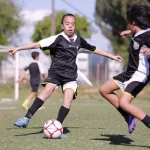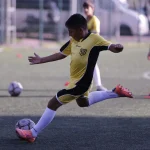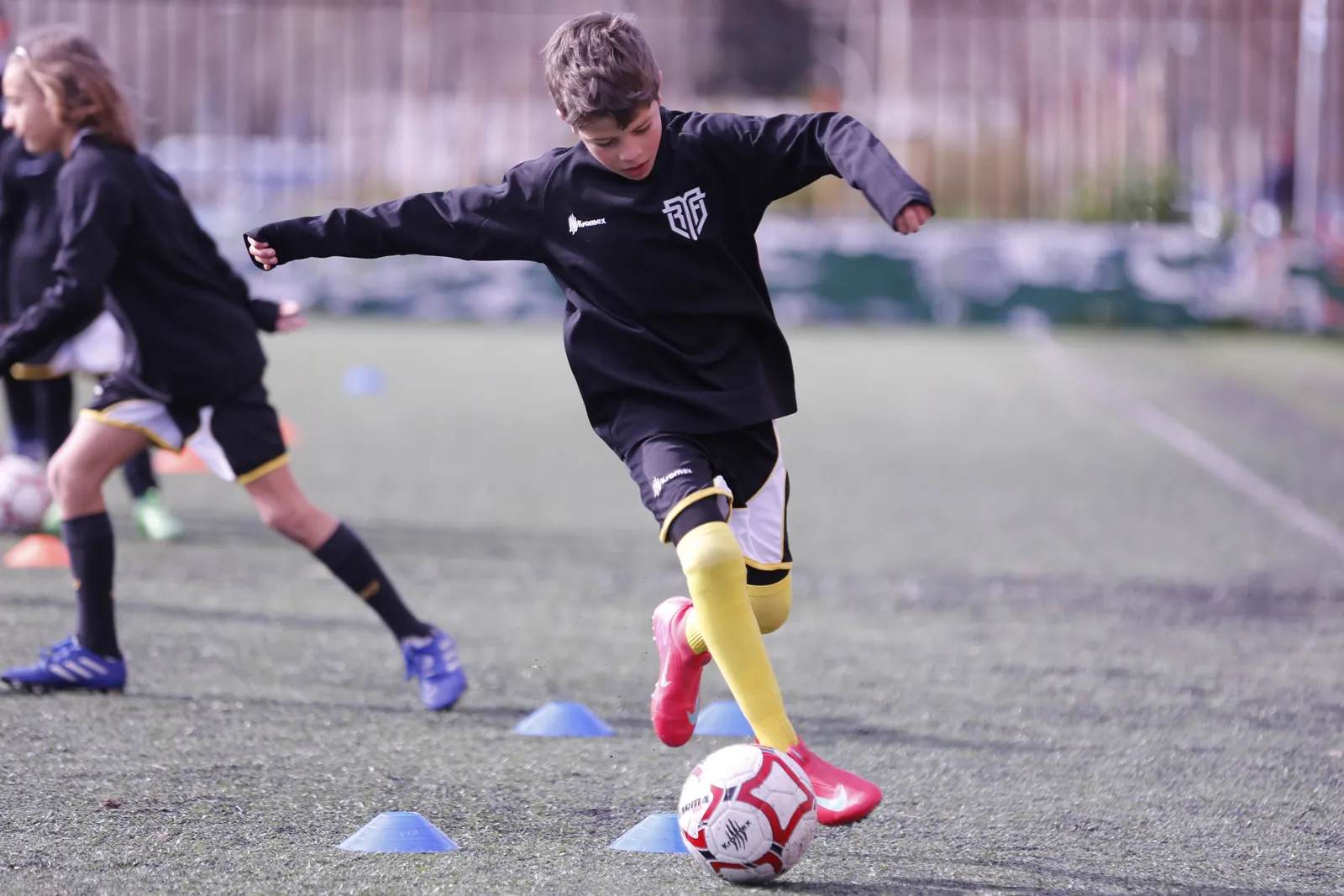
“My son only uses his right foot.” It’s one of the phrases I hear most from families when they come to our technical training sessions in Alcalá de Henares. And it makes sense: almost all children start playing with their dominant foot because it gives them confidence. The problem comes when the game speeds up and the opponent already knows which way they’ll always turn.
In this article I explain why learning to play with both feet is one of the best investments a young player can make, which errors we see most often and how we work on it at MR Fútbol Academy week by week.
Why playing with both feet matters so much
A footballer who only masters one foot plays with half the pitch closed off. When they receive, they need to shift the ball onto their good side, and that extra touch is time the opponent uses to press. On the other hand, a player who feels comfortable with both feet:
- Decides faster, because they have more real options in each action.
- Is harder to defend against: the opponent can’t show them onto their weak foot.
- Protects the ball better, by being able to dribble and control with the foot furthest from the defender.
- Has more passing and shooting angles, especially in tight spaces and near the box.
- Can play in more positions, something club coaches value highly.
It isn’t about the two feet being identical. It’s about the non-dominant foot no longer being a problem and becoming a resource.
The most common errors when working on the weak foot
1. Training it only “when it’s time”
Many players give their non-dominant foot five odd minutes at the end of training. That way nothing sticks. The weak foot improves when it’s used constantly, within the usual exercises.
2. Doing it without opposition or decisions
Striking against a wall helps at first, but in a match the weak foot has to appear with an opponent close by and little time. If it’s only trained in comfortable situations, the player goes back to their good foot in matches.
3. Correcting only the strike
Using both feet isn’t just about striking with the left or the right. It includes how the body is set, how the ball is controlled, which way you dribble and how you take players on. If the body shape doesn’t change, neither will the foot.
How we work on it at MR Fútbol Academy
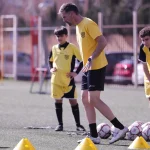
In our technical training working both sides isn’t a separate exercise: it’s present throughout the session. Each session lasts 60 minutes, in groups of up to 10 players with 2 coaches, and always follows the same four-block structure.
Block 1: warm-up game
A game linked to what we’re going to work on that day. From the first minute we introduce rules that require using both feet, so that the player starts to make it normal without realising.
Block 2: passing, body shape and control
Here we work on the directional first touch and body shape on both sides. A good touch with the non-dominant foot, leaving the ball ready for the next action, is worth more than lots of isolated strikes.
Block 3: 1v1, 1v2 and 2v1
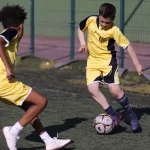
Real dribbling and decision-making situations. We teach a dribbling sequence that doesn’t change: measure the opponent, commit them, adjust the distance, lower the centre of gravity, slow down, feint and accelerate. The player practises it going both ways, not just the comfortable one.
Block 4: mirrored finishing
All finishing is mirrored: the same exercise on the left side and on the right side. We vary the way of finishing (side-on, back to goal, with a directional touch or after a dribble) and the player has to finish with both feet. Also, by organising the task on both sides, queues are shorter and each player touches the ball many more times.
Throughout all the blocks, the two coaches give individual feedback: we correct the standing foot, body orientation and contact surface, which is what really makes the non-dominant foot progress.
What your child can do at home
The weekly session sets the path, but a few extra minutes at home or in the park greatly speed up the process:
- Short dribbles using only the non-dominant foot, with gentle changes of direction.
- Passes against a wall alternating feet: first standing still, then controlling and passing with the same foot.
- Keepie-uppies always starting and finishing with the weak foot.
- Playing kickabouts with friends with one rule: a goal with the non-dominant foot counts double.
What matters is consistency, not duration. A short time several times a week is better than a long session every now and then.
Frequently asked questions
At what age should you start working on both feet?
The sooner the better. At young ages the player’s preference for one foot isn’t so settled and they integrate it naturally. Even so, it’s never too late: we also see older youth players progress a lot when they work on it consistently.
How long does it take to notice improvement?
It depends on each player and what they practise outside the session. What we do see in our groups is that, with weekly work and individual feedback, the non-dominant foot starts to appear in matches much sooner than families expect.
Does technical training replace club training?
No, it complements it. At the club the coach works with many players at once and prepares matches. In technical training we focus on each player’s individual technique, with small groups and much more contact with the ball.
Come and try it
We train at AD Complutense and Gredos San Diego Alcalá, with boys and girls aged 5 to 17. The fee is €65 a month, with no registration fee and kit included.
If you want your son or daughter to start playing with both feet, book their place o write to us on WhatsApp and we’ll tell you which group best suits their age.