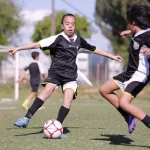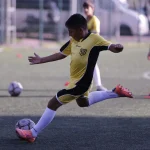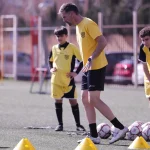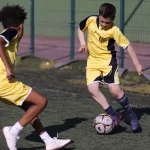
Few actions in football lift the crowd like a good dribble. But behind that seemingly improvised moment there’s a lot of work: reading the defender, choosing the moment and executing with the right foot. If your son or daughter wants to improve their dribbling in football, the good news is that it can be trained, a lot. The bad news is that repeating step-overs in front of a mirror isn’t enough.
In this article I explain, from my experience as a UEFA Pro licensed coach, how we work on dribbling at MR Fútbol Academy, which errors we see most often in youth players and what a player can do to really progress.
Dribbling isn’t a trick: it’s a decision
The most common mistake is thinking that dribbling means knowing lots of feints. Feints help, of course, but dribbling starts earlier: in the head. A player who dribbles well is, above all, a player who knows when to dribble, where y and why.
Dribbling in your own box with your team out of position is almost never a good idea. Taking someone on in the final third with space behind the defender, on the other hand, can change a match. That’s why in our sessions dribbling always goes hand in hand with decision-making: the player doesn’t just execute, they also choose.
The dribbling sequence we teach step by step
To turn dribbling from a matter of inspiration into something the player masters, we break it into phases. It’s the same sequence we repeat session after session with players aged 5 to 17, adapting the demands to each age:
- Measure the opponent: watch how they defend, whether they’re side-on, whether they’re coming quickly or waiting.
- Commit them: dribble towards them to force a decision and stop them backing off.
- Adjust the distance: not so far that they have time to react, nor so close that they can get a foot in.
- Lower your centre of gravity: bend your legs slightly to gain balance and the ability to change direction.
- Slow down: brake for an instant so the defender also brakes and is left planted.
- Feint: the deception, with the body, the eyes or the ball.
- Accelerate: burst into the space that has opened up.
When a player fails with a dribble, they’ve almost always skipped one of these steps. The most common is not slowing down: the player arrives at full speed, feints without having committed the defender and runs into the opponent’s leg. The change of pace is often more important than the feint itself.
Common dribbling errors in youth football
Looking only at the ball
If the head is always down, the player can’t see the defender, the support or the space. We work on dribbling with the head up from the earliest ages so that dribbling relies on information and not on luck.
Always dribbling to the same side
Many young players only feel comfortable going onto their strong foot, and defenders spot it straight away. That’s why at MR Fútbol we use mirrored work: every exercise is done to the left and to the right. If you’d like to explore this further, I recommend our article on how to play with both feet.
Collecting feints without using them
It’s better to master two or three moves effectively than to know ten and not know when to use them. A simple feint, well executed at the right moment, is worth more than a flashy move with no purpose.
Forgetting what happens next
Beating the opponent isn’t the end of the move. After the dribble you have to decide: pass, carry on or finish. A dribble that ends in losing the ball hasn’t achieved much.
How we train dribbling at MR Fútbol Academy
Our football technical training sessions last 60 minutes and always follow the same four-block structure. Dribbling appears in all of them, directly or indirectly:
- Warm-up game linked to the objective: ball games that already include dribbling, changes of direction and deceptive situations.
- Passing, body shape and control: a good dribble starts with a good touch. If the first touch leaves the ball well directed, the player reaches the duel with an advantage. This is where directional first touch.
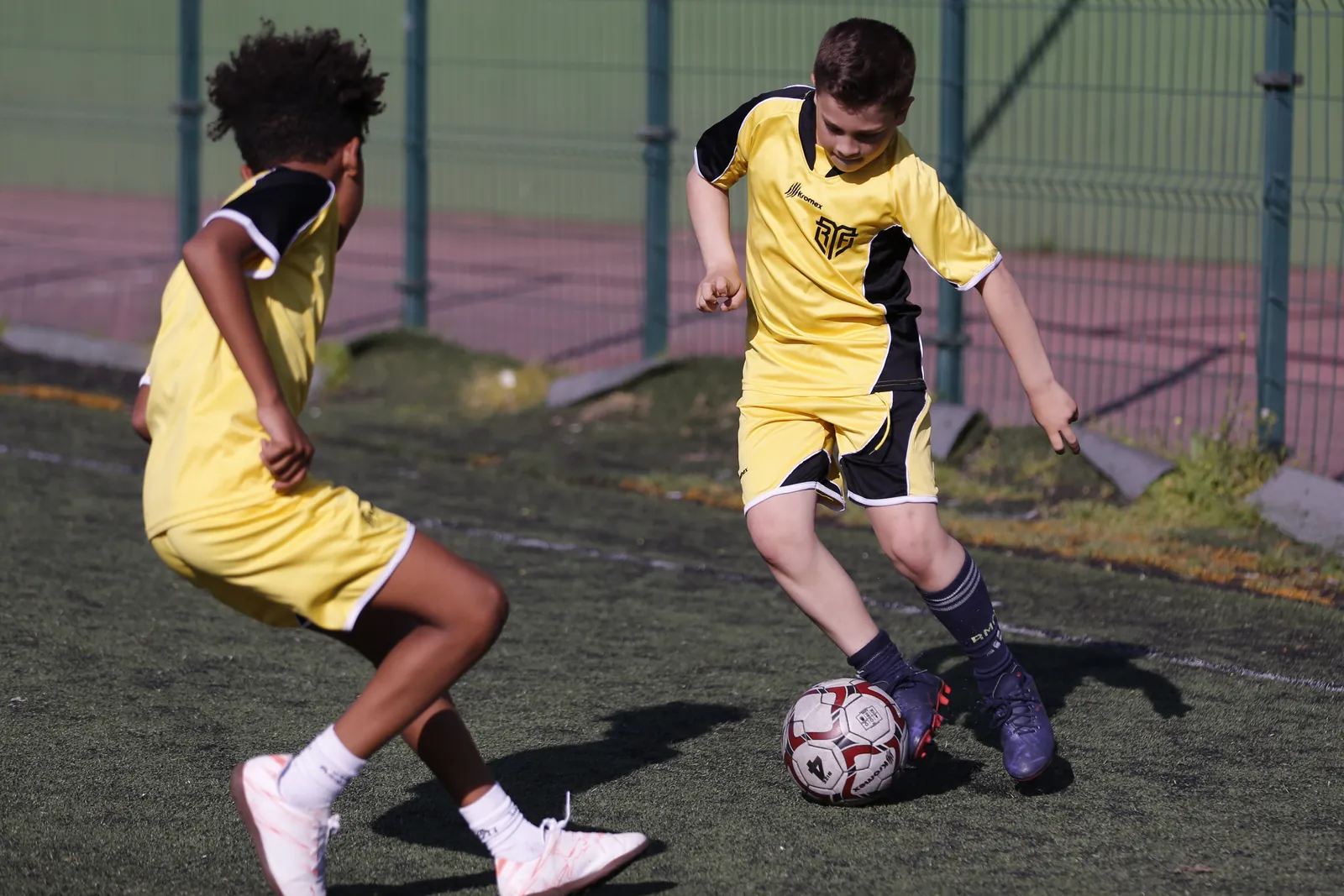
- 1v1, 1v2 and 2v1 with dribbling and decision-making: the core of the work. The player faces real defenders and has to decide whether to take them on, play off a team-mate or shield the ball.
- Finishing on goal: varying the way of finishing, so the dribble has continuity and ends in a chance.
We work in groups of up to 10 players with 2 coaches per group. This allows us to give individual feedback in every repetition: correcting the distance, the posture, the moment of acceleration. That immediate correction is what turns repetition into learning.
Tips for practising dribbling outside training
Technique improves with contact with the ball. Some simple ideas for the player to keep progressing at home or in the park:
- Dribbling with changes of pace: alternate slow and fast stretches, stopping with the sole and going away with the outside or inside of the foot.
- Always use both feet: if they do an exercise with the right, they should repeat it with the left.
- Play 1v1 with friends or siblings: there’s no better training than an opponent trying to take the ball off you.
- Watch football with intent: notice how players brake before taking someone on, more than the feint itself.
And a tip for families: let them make mistakes. Dribbling is learned by failing. A player who is told off for every lost ball ends up not trying any more, and that fear holds back their development far more than any technical shortcoming.
Frequently asked questions about dribbling in football
At what age should you start working on dribbling?
From the beginning. At the youngest ages we work on it through play, with lots of dribbling and simple 1v1 situations. As the player grows, we add more demands in decision-making and speed of execution.
Can a player who isn’t fast be a good dribbler?
Yes. Speed helps, but dribbling depends much more on change of pace, deception and choosing the moment. Many of the best dribblers aren’t the fastest, but those who read the defender best.
Does technical training replace training with the club?
No, it complements it. The player competes and trains with their club, and at MR Fútbol works on their individual technique with more repetitions and more personal attention than is possible in a team session. The two add up.
Come and try a technical training session
If you want your son or daughter to improve their dribbling with a clear method and individual corrections, we look forward to seeing you at our venues in Alcalá de Henares: the Complutense venue (Saturdays 16:00–20:00 and Sundays 10:00–20:00) and the Gredos San Diego Alcalá venue (Sundays 10:00–12:00). For players aged 5 to 17, €65/month, with no registration fee and kit included.
Book a trial session from our contact or write to us directly on WhatsApp on +34 644 218 207. We’ll help you find the group and time that suit you best.