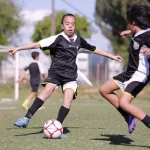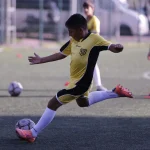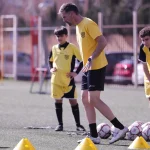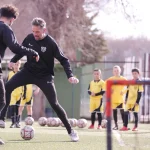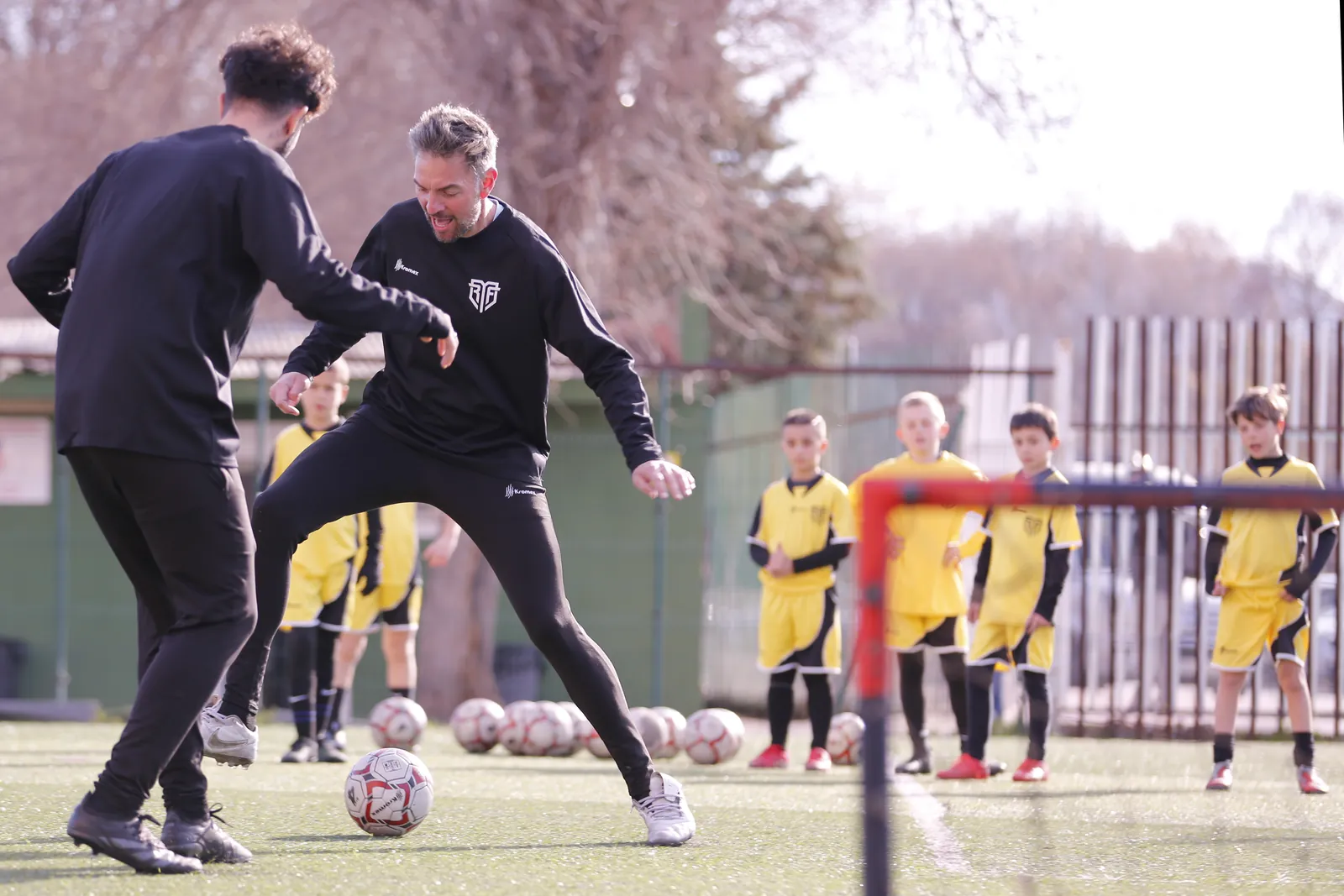
There are more and more football technical academies. And we see more and more academies that were created to improve footballers individually but that, over time, have started creating teams, playing in leagues and tournaments and competing for results.
From the outside it may look like a logical evolution. We believe exactly the opposite.
When a technical academy starts behaving like a club, it risks no longer doing what it was really needed for.
The player already has a team. They already have team-mates, a coach and competition. They already play matches every weekend. So the question is obvious: why do they need another team?
At MR Fútbol Academy, our football technical academy in Alcalá de Henares, we’re very clear: the player doesn’t need to compete more. They need to make better use of the time they spend improving.
A technical academy shouldn’t be a second club
The club and the academy have different roles. The club has a collective responsibility: building a team, preparing matches, developing a playing model, organising positions and competing.
That’s precisely why there’s a very important space for the technical academy: doing what collective training finds harder.
Stopping with one player. Correcting a detail. Repeating. Correcting again. Working on body shape. Creating duels. Finishing. Deciding. Making mistakes. Trying again.
The academy should provide specialisation. If it ends up creating another team, preparing for another competition and chasing another result, it starts to duplicate roles. And the more it looks like a club, the less clear it is why the footballer needs both.
Technical academy vs. competing academy
| Aspect | Technical academy | Competing academy |
|---|---|---|
| Focus of the project | The player | The team |
| The coach’s question | What does this player need to improve? | What does the team need to win? |
| The result that matters | The player’s progress | The weekend’s score |
| Preparing matches and systems | No | Yes, it’s necessary |
| Technical repetitions | Very high | Limited by match preparation |
| Individual correction | Constant | Harder with large squads |
| Squad selection and minutes | Don’t affect learning | Can affect decisions |
| Relationship with the player’s club | Complements it | May overlap with it |
The hidden cost of turning an academy into a team
Imagine a group of ten players. As long as the goal is technical improvement, the coach’s question is: how do I get these ten players to improve?
Now let’s form a team and enter it in a competition. New questions automatically appear: who plays centre-back? who starts on the bench? how do we press? what do we do at set pieces? how do we share out the minutes?
None of those questions is wrong. The problem is that every minute spent solving them is a minute no longer spent on individual improvement.
More matches doesn’t mean more development
In youth football it’s common to think: more matches = more football = more learning. Not necessarily.
A match is extraordinary for expressing skills, but it’s not always the most efficient setting for acquiring them. And young players already compete a great deal: they train with their club, play at the weekend and also add tournaments, friendlies and camps. If the academy wants to compete too, it’s worth asking whether what that player lacks is another match.
In most cases they need something much less spectacular: more ball, more executions, more corrections, more 1v1s, more touches, more finishes and more chances to make mistakes and try again.
If you want to improve 1v1, create 1v1s
If we want to improve a winger’s dribbling, we can wait for a few 1v1 situations to appear in a match, or design a session where they appear one after another. That’s technical training: not removing the game context, but manipulating it to multiply learning opportunities.
Technical training requires knowing about technique
Technical coaching isn’t just setting up exercises with a ball. To do it well you need four things:
- Technical knowledge: knowing how each movement is executed (control, passing, dribbling, 1v1 moves, striking) and which details make the difference.
- A methodology: your own method that explains what is worked on, why and in what order.
- Planning: objectives by week and by stage, adapted to each player’s age and level.
- A session structure: each session with defined parts and a common thread, not isolated exercises.
And, above all, you have to know how to correct. Saying “again” or “better” isn’t enough. The coach has to spot the error, understand where it comes from (the standing foot, the body shape, the contact surface, the moment of looking up…) and give precise feedback that the player can apply in the next repetition.
The warning signs
The problem appears when whoever runs the session doesn’t master technical football. Then the session fills up with whatever is easiest to set up: rondos, coordination ladders, hoops and combined actions. These are common resources for inexperienced coaches, because they’re quick to organise and keep children busy. But rondos are mainly tactical work, and ladders and hoops are coordination. None of them is technical training.
And there’s another model repeated at many technical academies:
- Coaches with little or no education in technical football and no methodology behind them.
- Working in stations that rotate every few minutes.
- Groups with no age criteria, with children training alongside team-mates twice their age.
- 20 or more children on the same pitch at the same time, with a single coach for 5 or 6 stations.
- Nobody monitors what each player is doing: no feedback on what they do well or what they need to correct.
If you see that this is the basis of a technical academy’s sessions, you know there’s no methodology, no structure and technique isn’t being trained. The child is busy, but not improving.
What we do at MR Fútbol every weekend
The difference can be seen on the pitch:
- Few players and a ratio of 5 players per coach.
- Coaches trained in technical football, always aware of what each player is doing.
- One exercise for the whole group, with a clear explanation of what we’re aiming for and why.
- Individual correction, player by player, and personal feedback in every repetition.
That way, every minute of the session serves the player’s technical improvement.
When you can’t coach technique, you compete
And this is where the circle closes. When an academy doesn’t know how to improve a player’s technique, the easiest thing is to fill the calendar with tournaments and matches with no criteria. The match entertains, gives a feeling of activity and covers up the lack of content.
But let’s think about how football works at any level, whether professional, amateur or youth: you train and you compete once a week, in regulated federated leagues. Development is built in training. If the academy turns its time into more competition, it’s taking away exactly what the player lacks.
The score changes decisions
As soon as there’s competition the result appears, and the result changes decisions. The coach may want a player to take a risk in a 1v1 or to try them in another position, but if the match is decisive there’s a natural tension between developing and winning.
That’s part of football and players need to learn it at their club. That’s precisely why we believe there must be another space, free of that pressure, where the question is what does this footballer need to be better six months from now? and not what do I have to do to win on Saturday?
So doesn’t competition develop players?
Of course it does. Footballers need to compete: they need opponents, uncertainty, pressure, a score and consequences.
Our criticism isn’t of competition. It’s of redundancy. Players need to compete, but they don’t need every environment they train in to become a competition.
Our scoreboard is the player’s progress
At MR Fútbol we don’t want to win Saturday’s match. We want our players to play that match better.
If a player has a better directional first touch with their club, sets their body before receiving, looks up, takes on a 1v1 they used to avoid or finishes better, that’s our result.
That’s also why we don’t need to take a player away from anyone. We don’t sign players, we don’t persuade anyone to leave their team and we don’t build squads. The player comes from their club, trains with us and goes back to their club better. We don’t compete with the club: we add.
Specialising means giving things up. Offering teams, leagues, tournaments and trips may be commercially attractive, but offering more things isn’t specialising better. We’ve decided that our product is one thing: the footballer’s individual improvement.
How we work at MR Fútbol Academy
Our whole structure is designed so that each player touches the ball more and gets more attention:
- Small groups of up to 10 players with 2 coaches, so correction is individual and constant.
- 60-minute sessions with our own methodology of 4 specific blocks: a warm-up linked to the objective, passing, body shape and control, 1v1, 1v2 and 2v1 situations, and finishing.
- Work with both feet: everything done to one side is repeated to the other.
- Technical direction by a a UEFA Pro licensed coach.
- Players aged 5 to 17 at our venues in Alcalá de Henares: Complutense and Gredos San Diego.
You can see all the details on our football technical training in Alcalá de Henares.
Before choosing an academy, ask one question
What will you offer my child that they don’t already have at their club?
If the answer is more teams, more matches, more leagues and more tournaments, it’s worth asking whether that’s what they really need.
If the answer is more individual attention, more repetitions, more corrections, more contact with the ball and more decision-making, then we’re talking about technical training. To check, also ask:
- How many players are there per coach?
- How much of the session is my child on the ball?
- Do you correct them individually or only as a group?
- How do you correct a technical error? Do you explain where it comes from?
- Does what you do complement their club or compete with it?
Frequently asked questions
Does my child have to leave their club to train at MR Fútbol?
No. Our model is complementary: the player stays at their club, with their team and coach, and comes to our sessions to work on their individual technique.
Why don’t you have teams or compete in leagues?
Because preparing matches takes time away from individual improvement, which is what we do. The player already competes with their club; we work so they compete better.
How many times a week do they train?
One weekly 60-minute session, compatible with club training and matches. The fee is €65 a month, with no registration fee and kit included.
Your club is where you compete
We don’t want to replace the player’s coach, team or club. We want them to be a better footballer when they go back.
YOUR CLUB IS WHERE YOU COMPETE. MR FÚTBOL IS WHERE WE WORK SO YOU COMPETE BETTER.
Book a trial session or write to us on WhatsApp on +34 644 218 207.